
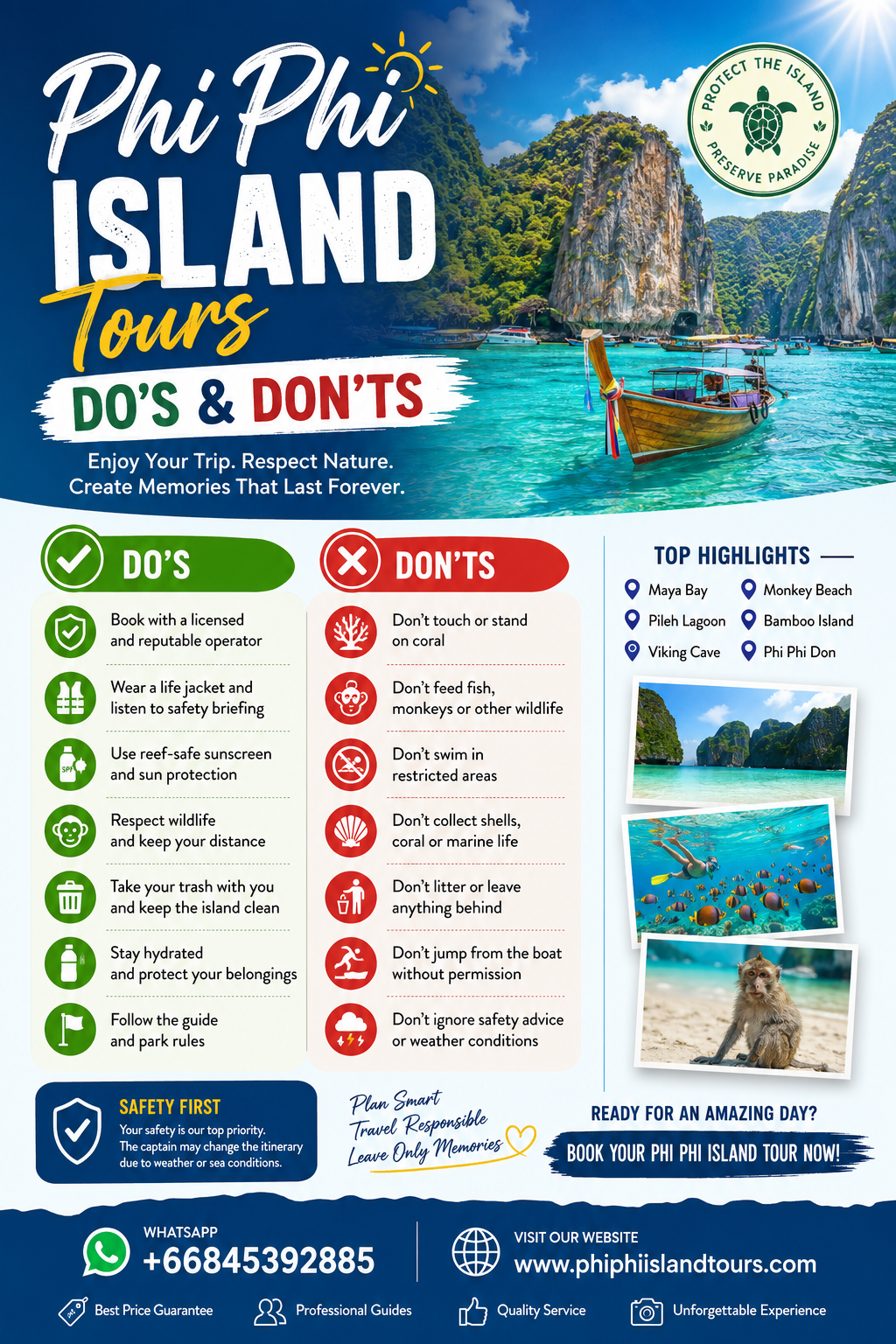
Phi Phi Island Tours Do’s and Don’ts: Essential Travel Guide
Planning a tropical adventure in southern Thailand? Understanding the essential Phi Phi Island tours do’s and don’ts can help you enjoy a safer, more comfortable, and more responsible island experience.
The Phi Phi Islands are famous for dramatic limestone cliffs, turquoise water, white-sand beaches, colorful marine life, and world-renowned attractions such as Maya Bay, Pileh Lagoon, Viking Cave, Monkey Beach, and Phi Phi Don.
However, a successful trip requires more than choosing a beautiful tour. Visitors must also follow marine park regulations, listen to safety instructions, respect wildlife, and prepare properly for a full day at sea.
This guide explains what you should and should not do during a Phi Phi Island tour from Phuket, Krabi, or nearby destinations.
Before Your Phi Phi Island Tour
Phi Phi Island tours are available in several formats, including speedboat tours, catamaran tours, ferry trips, private charters, snorkeling excursions, and overnight packages.
Before booking, compare the itinerary, boat type, departure point, meal arrangements, hotel transfer coverage, insurance conditions, national park fees, and cancellation policy.
A cheaper tour is not always the best option. Boat capacity, crew experience, safety equipment, departure time, and the number of stops can significantly affect your experience.
Check the Exact Tour Inclusions
Ask the tour operator whether the package includes:
- Hotel transfers
- National park admission fees
- Snorkeling equipment
- Life jackets
- Lunch, drinking water, and refreshments
- English-speaking guide
- Accident insurance
- Beach towels
- Fin rental or prescription masks
Do not assume that every package includes the same services. Inclusions vary among operators and tour types.
Review the Weather and Sea Conditions
Weather in the Andaman Sea can change quickly. Rain does not always mean a tour will be cancelled, but strong winds, large waves, or official marine warnings may affect the itinerary.
Contact your tour operator before departure if the forecast looks uncertain. The captain may change the route or cancel particular stops when safety conditions require it.
Phi Phi Island Tours: What You Should Do
1. Do Book with a Licensed and Reputable Operator
Choose an established tour operator that provides trained crew members, appropriate insurance, functioning communication equipment, and enough life jackets for all passengers.
Review the itinerary carefully and confirm which boat will be used. Speedboats are faster, while larger vessels may offer more space and a smoother ride in moderate conditions.
2. Do Arrive at the Meeting Point on Time
Shared tours operate according to fixed departure schedules. Arriving late can delay other passengers or cause you to miss the boat.
Prepare your booking confirmation, identification document, and any required passenger information before reaching the check-in counter.
3. Do Listen to the Safety Briefing
Pay close attention when the guide explains how to board the boat, use a life jacket, enter the water, identify the meeting point, and respond in an emergency.
Even experienced swimmers should follow the guide’s instructions. Currents, boat traffic, waves, and underwater conditions can differ significantly from those at a swimming pool or sheltered beach.
4. Do Wear a Life Jacket When Required
Wear the life jacket correctly during boat travel and snorkeling whenever instructed. Children and inexperienced swimmers should keep their life jackets on near the water unless the crew confirms that removal is safe.
Make sure the straps are secure and ask the crew for a different size if the jacket does not fit properly.
5. Do Use Sun Protection Responsibly
The tropical sun can be intense even on cloudy days. Wear a hat, sunglasses, lightweight clothing, and a long-sleeved rash guard when possible.
Apply sunscreen before boarding and follow current national park or tour-operator requirements concerning permitted sunscreen products. Avoid applying sunscreen immediately before entering the sea because it may wash directly into the water.
6. Do Keep Your Valuables Dry
Place your phone, passport copy, wallet, camera, and medication in a waterproof dry bag or sealed pouch.
Water can enter the boat during boarding, rough conditions, or sudden rain. A normal backpack is not necessarily waterproof.
7. Do Follow the Guide at Every Stop
Stay within the designated visitor areas and return to the boat at the announced time. Tour schedules are affected by tides, park regulations, weather, and other boat movements.
Tell the guide before leaving the group, even when visiting a restroom, café, or nearby viewpoint.
8. Do Respect Local Communities
Phi Phi Don is not only a tourist attraction. It is also home to local residents, tourism workers, restaurants, hotels, and community businesses.
Dress appropriately away from the beach, keep noise at a reasonable level, use designated waste bins, and treat local staff respectfully.
9. Do Stay Hydrated
Drink water regularly throughout the day. Sun exposure, swimming, snorkeling, and boat travel can cause dehydration faster than many travelers expect.
Limit alcohol before and during marine activities because it can impair judgment, balance, and swimming ability.
10. Do Inform the Operator About Medical Conditions
Before departure, disclose relevant conditions such as pregnancy, recent surgery, back or neck problems, heart conditions, severe motion sickness, mobility limitations, or serious allergies.
Boat travel—especially by speedboat—may involve repeated impact from waves. The operator needs accurate information to determine whether the trip is suitable.
Phi Phi Island Tours: What You Should Not Do
1. Don’t Touch or Stand on Coral
Coral is a living and highly sensitive marine organism. Touching, kicking, or standing on it can cause permanent damage.
Keep your body horizontal while snorkeling and maintain enough distance from shallow reefs. Ask for a life jacket or flotation aid if you cannot control your position comfortably.
2. Don’t Collect Shells, Coral, or Marine Life
Do not remove coral fragments, shells, sand, plants, or animals from protected areas. Natural objects are part of the ecosystem and may also be protected by national park regulations.
Take photographs instead of souvenirs from nature.
3. Don’t Feed Fish, Monkeys, or Other Wildlife
Feeding wildlife changes its natural behavior, creates dependence on visitors, and can lead to aggressive encounters.
Monkeys can bite, scratch, or grab bags and phones. Observe them from a safe distance and keep food securely stored.
4. Don’t Swim in Restricted Areas
Some bays, beaches, coral zones, and boat channels may be closed to swimming. Restrictions may be introduced to protect visitors, sharks, coral reefs, seagrass, or other marine resources.
Obey signs, barriers, park officers, and tour guides even when the water appears calm.
5. Don’t Jump from the Boat Without Permission
Never jump into the water until the crew confirms that the boat is secure and the area is safe.
There may be shallow rocks, coral, currents, propellers, ropes, or other vessels nearby. Use the designated ladder or entry point.
6. Don’t Litter
Do not leave plastic bottles, food containers, cigarette ends, wet wipes, or packaging on beaches or boats.
Keep your rubbish with you until a suitable bin is available. Lightweight plastic can easily blow into the sea.
7. Don’t Ignore Seasickness Preparation
If you are susceptible to motion sickness, do not wait until the boat is moving before taking action.
Consult a qualified medical professional or pharmacist about an appropriate remedy. Eat a light meal before departure, avoid excessive alcohol, and sit where directed by the crew.
8. Don’t Bring Unnecessary Valuables
Avoid carrying expensive jewelry, large amounts of cash, or electronic equipment that you do not need.
The boat operator may not be responsible for items lost in the water, left on beaches, or damaged by saltwater.
9. Don’t Fly a Drone Without Permission
Drone operation may be restricted by national park rules, aviation regulations, local conditions, or privacy requirements.
Do not launch a drone from a beach, pier, national park area, or boat without confirming that you have all required registrations and permissions.
10. Don’t Pressure the Crew to Continue in Unsafe Conditions
The captain may modify the itinerary because of waves, wind, visibility, tides, congestion, or official instructions.
No attraction is more important than passenger safety. Accept route changes when the crew determines that a planned stop is unsafe or inaccessible.
Maya Bay Do’s and Don’ts
Maya Bay is located on Phi Phi Leh within the Hat Noppharat Thara–Mu Ko Phi Phi National Park. It is one of Thailand’s most sensitive and closely managed natural attractions.
Visitor regulations may include designated walking routes, controlled entry points, restrictions on swimming, restrictions on approaching wildlife, and seasonal closures for environmental recovery and visitor safety.
Do at Maya Bay
- Stay on designated paths and visitor areas.
- Follow instructions from park officers and your guide.
- Keep a respectful distance from sharks and other wildlife.
- Take all personal belongings and rubbish with you.
- Check the current opening status before booking your tour.
- Allow enough time to return to the boat with your group.
Don’t at Maya Bay
- Do not swim when swimming is prohibited.
- Do not cross barriers or enter conservation zones.
- Do not chase, touch, or feed marine animals.
- Do not leave food, plastic, or cigarette waste on the beach.
- Do not assume access is guaranteed throughout the year.
- Do not ignore instructions because another visitor is breaking the rules.
Important: Maya Bay access rules, opening periods, operating hours, and visitor limits can change. Confirm the latest conditions with the national park or your licensed tour operator before travelling.
What to Bring on a Phi Phi Island Tour
A well-prepared packing list makes the trip considerably more comfortable.
- Swimwear worn under lightweight clothing
- Quick-drying shirt or rash guard
- Hat and UV-protection sunglasses
- Approved sunscreen suitable for current park requirements
- Waterproof phone pouch
- Small dry bag
- Beach towel, when not supplied
- Personal medication
- Motion-sickness medication, when medically appropriate
- Reusable water bottle, when permitted by the operator
- Small amount of Thai baht
- Booking confirmation and requested identification
- Water-resistant sandals or secure footwear
- Change of dry clothes
Pack lightly because storage space may be limited, particularly on speedboats.
Essential Phi Phi Island Tour Safety Tips
Choose the Right Boat for Your Needs
A speedboat may reduce travel time but can feel more forceful when crossing waves. A larger boat may provide additional space, although the journey can take longer.
Travelers with back problems, recent surgery, pregnancy, or certain medical conditions should obtain professional medical advice and consult the operator before booking.
Supervise Children Closely
Parents and guardians should supervise children at all times, including on the boat, at piers, on beaches, and during snorkeling.
Do not rely entirely on guides or crew members to provide individual childcare.
Be Careful Around Boat Propellers
Never swim behind a boat or approach an engine area. Wait until the crew confirms that the engine is off and the water-entry zone is safe.
Know Your Swimming Ability
Do not enter deep water simply because other passengers are doing so. Tell the guide honestly if you cannot swim or have limited snorkeling experience.
A flotation device can improve buoyancy, but it does not replace supervision, correct equipment, or safe decision-making.
Protect Yourself from Heat
Seek shade when available, drink water, and monitor for headache, dizziness, nausea, unusual fatigue, or confusion.
Inform the crew immediately if you or another passenger develops symptoms of heat exhaustion.
How to Be a Responsible Phi Phi Island Visitor
Responsible tourism helps protect the Phi Phi Islands for future generations. Every visitor can reduce their environmental impact through simple decisions.
- Choose an operator that follows park and marine safety regulations.
- Bring reusable items instead of unnecessary single-use plastic.
- Keep a safe distance from coral and wildlife.
- Do not purchase souvenirs made from coral, shells, or protected animals.
- Use established toilets and waste facilities.
- Support legitimate local businesses.
- Follow visitor limits and seasonal closures without complaint.
- Report dangerous or environmentally harmful behavior to the guide.
The best Phi Phi Island tour is not only visually impressive. It should also protect passengers, respect local communities, and minimize damage to the marine environment.
Quick Phi Phi Island Tours Do’s and Don’ts Checklist
Do
- Book with a reputable tour operator.
- Check the weather and current park rules.
- Arrive on time.
- Wear a life jacket when instructed.
- Protect your belongings from water.
- Stay hydrated.
- Respect wildlife and local communities.
- Follow the guide and captain.
Don’t
- Touch or stand on coral.
- Feed monkeys or fish.
- Swim in restricted areas.
- Leave rubbish behind.
- Remove shells or natural objects.
- Jump from the boat without permission.
- Ignore medical or safety advice.
- Pressure the captain to travel in unsafe conditions.
Frequently Asked Questions About Phi Phi Island Tours
Can you swim at Maya Bay?
Swimming access at Maya Bay is subject to national park conservation rules and may be prohibited or restricted. Visitors must follow the instructions displayed at the site and provided by park officers or tour guides.
Are Phi Phi Island tours suitable for children?
Many tours accept children, but suitability depends on the child’s age, health, swimming ability, boat type, weather, and itinerary. Parents should confirm minimum-age policies and supervise children throughout the trip.
What should I wear on a Phi Phi Island tour?
Wear swimwear under lightweight, quick-drying clothing. A rash guard, hat, secure sandals, and sunglasses are useful for sun and water activities.
Do I need to know how to swim?
You can still join many sightseeing tours without swimming. However, inform the operator before booking and tell the guide before any water activity. Wear an appropriate life jacket and avoid entering conditions beyond your ability.
Are national park fees included in the tour price?
It depends on the package. Some operators include the fee, while others collect it separately. Check the written inclusions before booking because fees and collection procedures may change.
Can pregnant travelers join a speedboat tour?
Many operators restrict speedboat travel during pregnancy because repeated impact from waves can create safety risks. Consult a qualified medical professional and obtain the operator’s policy before booking.
What happens when the weather is bad?
The operator may delay departure, adjust the route, replace a destination, or cancel the tour. The captain’s safety decision should be treated as final.
Can I bring food for the monkeys?
No. Visitors should not feed monkeys or other wildlife. Feeding may cause aggressive behavior, health problems, and disruption of natural feeding patterns.
Is a private Phi Phi Island tour better than a shared tour?
A private tour usually provides greater flexibility and privacy, while a shared tour is generally more economical. Both can be enjoyable when operated safely and responsibly.
When should I confirm Maya Bay’s opening status?
Check before booking and again shortly before departure. Seasonal conservation closures, weather, and official park decisions may affect access.
Final Thoughts
Knowing the essential Phi Phi Island tours do’s and don’ts will help you avoid common mistakes and enjoy the islands more responsibly.
Book with a professional operator, follow marine park regulations, wear the correct safety equipment, respect wildlife, and prepare for changing weather conditions. Most importantly, remember that Phi Phi is a protected natural destination—not simply a backdrop for photographs.
Travel carefully, leave no waste, and take home only memories of one of Thailand’s most remarkable island landscapes.
Contact us: Whatsapp No.: +66845392885